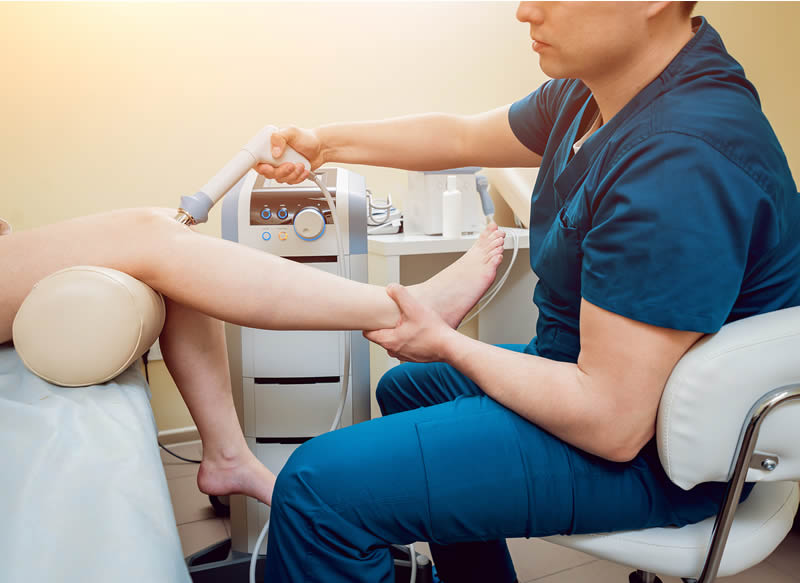
Shockwave Therapy
Shockwave therapy utilizes acoustic waves to deliver concentrated energy to target painful areas and myoskeletal tissues afflicted by subacute, subchronic, and chronic conditions. This energy stimulates the regeneration and repair of bones, tendons, and other soft tissues. Shockwaves are distinguished by abrupt changes in pressure, significant amplitude, and irregular frequency. The kinetic energy generated by compressed air propels a projectile, which then transfers energy to the transmitter located at the end of the applicator, effectively penetrating the tissue.
Shockwave therapy can be beneficial for knee pain in several ways:
- Pain Reduction: Shockwave therapy helps to alleviate knee pain by disrupting the pain signals being sent to the brain. It can effectively reduce pain sensation and improve comfort levels.
- Promotion of Healing: The energy delivered by shockwaves stimulates blood flow to the affected area, which in turn promotes tissue regeneration and accelerates the healing process. This can be particularly useful for conditions such as tendonitis or ligament injuries in the knee.
- Reduction of Inflammation: Shockwave therapy has anti-inflammatory effects, helping to reduce swelling and inflammation in the knee joint. By minimizing inflammation, it can alleviate associated pain and discomfort.
- Improved Mobility and Function: By enhancing tissue repair and reducing pain, shockwave therapy can improve mobility and functional capacity in individuals with knee pain. This may enable patients to perform daily activities with greater ease and comfort.
- Non-invasive Treatment Option: Shockwave therapy is a non-invasive treatment option for knee pain, which means it does not involve surgery or prolonged recovery periods. This makes it a favorable choice for individuals seeking conservative management of their knee condition.

Knee On Trac
By gently separating the joint space between the femur (thigh bone) and the tibia (shin bone), Knee on Trac therapy induces a vacuum effect within the knee joint. This phenomenon facilitates the influx of nutrient-rich fluid to the area, aiding in tissue nourishment and repair. Additionally, the traction exerted by Knee on Trac stretches the tendons, ligaments, and surrounding soft tissue, contributing to the restoration of natural joint space and cushioning in the knee.
Research findings have highlighted the multifaceted benefits of traction therapy. Studies indicate that it can stimulate bone growth (osteogenesis), enhance blood supply (angiogenesis), and improve joint mobility (viscoelasticity). Consequently, these physiological responses result in pain reduction, restoration of normal joint motion, and promotion of tissue healing.
What Are Some Of the Conditions That Respond Well To Knee Decompression?
- Knee joint degeneration
- Arthritis
- Meniscus tears
- Sprains/strains older than 6 weeks
- Oseochondritis dessicans
What Are The Results I Can Expect?
- Reduction of pain
- Increased joint mobility
- Increased joint function
- Enhanced cartilage repair
Are There Side Effects?
For certain patients, particularly those with advanced degeneration in the knee joint or significant scar tissue accumulation, mild soreness may occur after the initial sessions of treatment. This discomfort is often a natural response as the body adapts to the therapeutic process and undergoes tissue remodeling.
 Salt Lake Knee Clinic